


Modern web applications are expected to handle growing user bases, increasing data volumes, and frequent feature updates without breaking performance. Application Programming Interfaces (APIs) play a central role in making this scalability possible. They act as structured communication layers that allow systems to grow, adapt, and integrate efficiently.
Understanding how APIs support scalability helps teams design applications that remain flexible and reliable under pressure.
What APIs Do in Web Applications
APIs define how different parts of a system communicate with each other. Instead of tightly coupling components, APIs introduce clear boundaries between services, clients, and data sources.
Core responsibilities of APIs include:
- Exposing application functionality in a controlled way
- Enabling communication between frontend and backend systems
- Supporting integration with third-party services
- Standardizing data exchange formats
This separation is essential for scaling both development and infrastructure.
APIs as the Foundation of Scalability
Scalable web applications rely on modular architecture. APIs make this modularity practical.
Decoupling System Components
By separating concerns, APIs allow teams to scale individual components independently.
Benefits of decoupling include:
- Backend services can scale without frontend changes
- Multiple clients can use the same API
- Failures are isolated instead of cascading
This structure reduces risk as the application grows.
Supporting Horizontal Scaling
APIs enable horizontal scaling by allowing multiple instances of a service to handle requests concurrently.
Key advantages:
- Load can be distributed across servers
- Traffic spikes are handled more gracefully
- Infrastructure resources are used more efficiently
Stateless APIs are especially effective for horizontal scaling.
APIs in Microservices Architectures
Microservices depend heavily on APIs for communication between services.
Enabling Independent Deployment
Each microservice exposes its own API, allowing it to evolve independently.
This approach allows:
- Faster development cycles
- Smaller, focused codebases
- Independent scaling based on demand
APIs ensure services remain loosely coupled while still working together seamlessly.
API Gateways for Traffic Management
An API gateway acts as a single entry point for clients.
It helps with:
- Request routing
- Authentication and authorization
- Rate limiting and throttling
- Monitoring and analytics
Gateways simplify client interactions and protect backend services from overload.
APIs and Performance Optimization
Scalability is not just about handling more users—it also means maintaining performance.
Efficient Data Transfer
Well-designed APIs minimize payload sizes and reduce unnecessary requests.
Optimization strategies include:
- Pagination for large datasets
- Filtering and field selection
- Caching frequently requested responses
These practices reduce server load and improve response times.
Caching and Reusability
APIs allow responses to be cached at multiple levels.
Common caching layers:
- Client-side caching
- CDN caching
- Server-side caching
Reusing cached responses improves scalability without increasing infrastructure costs.
APIs and Team Scalability
Scalable applications also require scalable development processes.
Parallel Development
APIs allow frontend and backend teams to work independently.
Advantages include:
- Faster release cycles
- Clear contracts between teams
- Easier onboarding of new developers
Clear API documentation is critical to maintaining this efficiency.
Easier Integration and Expansion
As applications grow, APIs make it easier to add new features or integrations.
Examples:
- Mobile apps using the same backend APIs
- Third-party integrations without core system changes
- Partner platforms accessing limited functionality securely
APIs turn growth into an extension rather than a rebuild.
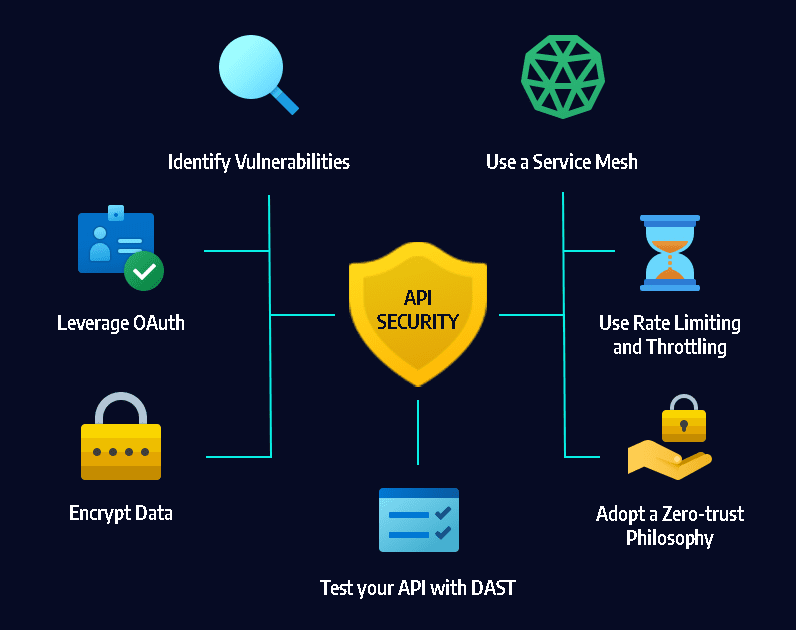
Security Considerations for Scalable APIs
As usage increases, APIs become more exposed and require strong security practices.
Key measures include:
- Authentication and authorization mechanisms
- Rate limiting to prevent abuse
- Input validation and error handling
- Monitoring for unusual traffic patterns
Secure APIs ensure scalability does not come at the cost of reliability or trust.

Future-Proofing Web Applications with APIs
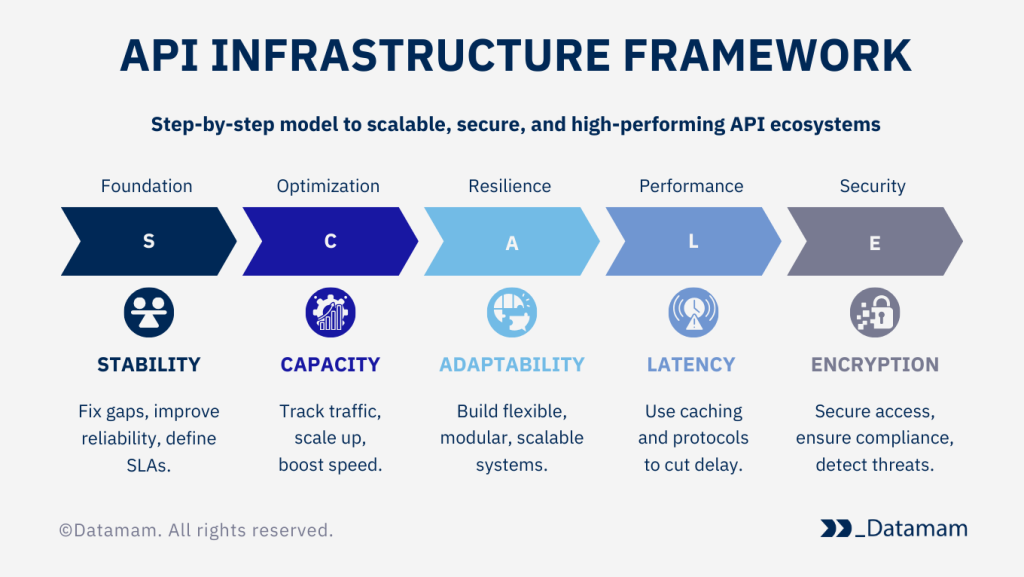
APIs make applications adaptable to change. Whether adopting new technologies, scaling globally, or integrating emerging platforms, APIs provide the flexibility needed to evolve without disruption.
When designed thoughtfully, APIs become long-term assets that support both technical and business growth.
Frequently Asked Questions
Why are APIs critical for scalable web applications?
APIs enable modular design, independent scaling, and seamless integration, all of which are essential for scalability.
Can a web application scale without using APIs?
While possible in small systems, scaling becomes difficult without APIs due to tight coupling and limited flexibility.
How do APIs help manage high traffic?
APIs support load balancing, caching, and horizontal scaling, allowing systems to handle large volumes of requests efficiently.
What makes an API scalable?
Stateless design, efficient data handling, caching strategies, and proper rate limiting all contribute to API scalability.
Do APIs slow down web applications?
Poorly designed APIs can add overhead, but optimized APIs often improve performance by streamlining data access and reuse.
How important is API documentation for scalability?
Extremely important. Clear documentation enables teams to scale development and integrations without confusion or delays.
Should APIs be versioned in scalable systems?
Yes. Versioning allows systems to evolve without breaking existing clients, which is crucial as usage grows.
APIs are more than technical connectors—they are the backbone of scalable web applications. By investing in strong API design early, teams set the stage for sustainable growth and long-term success.

Comments are closed.